
“Move fast and break things” was always a strange motto to borrow.
It worked for software companies because most of what they broke was recoverable. Ship a bad feature, users complain, and you roll it back a few days later. The cost of a mistake was low, and the feedback came quickly.
Learning doesn’t work that way.
When something breaks in how people develop, what gets damaged is harder to see. It might be a person’s confidence, a missed opportunity, or trust in a recommendation, and it might be a capability that never fully develops because nobody realized it was being outsourced to a machine. By the time the effects become visible, the damage has had time to spread.
A lot of organizations are bringing the move-fast mindset into AI adoption right now, and I understand why. Boards are asking for AI strategies, competitors are announcing initiatives, and leaders don’t want to be seen as falling behind. Speed starts to feel like proof of progress.
The challenge is that some of the biggest risks of AI adoption don’t show up immediately. They build while the early metrics look encouraging, and by the time they surface, organizations are dealing with consequences instead of making choices.
These are the four risks I keep coming back to in conversations with leaders.
Bias scales faster than judgment
Automating a learning decision often means handing it to a system trained on your organization’s own history.
Who gets identified as high potential.
Who receives development opportunities.
Who gets recommended for leadership programs.
Who quietly falls off the radar.
If historical patterns favored certain groups, the system can learn those patterns and reproduce them at scale. A manager’s biased judgment affects the people on that manager’s team. An automated recommendation engine applies the same judgment across the organization, and it does it before anyone notices a pattern forming.
What makes this especially difficult is that automated decisions often arrive with the appearance of objectivity. The recommendation feels data-driven. The output looks neutral. People assume someone has already checked it.
Sometimes nobody has.
Bias like this is discoverable. Finding it requires organizations to ask questions before a capability is scaled rather than after it becomes part of everyday work, and the pressure to move quickly pushes those questions to later.
Trust doesn’t rebuild on your timeline
Trust is the working capital of a learning organization.
People give you their attention because they believe you’re helping them grow, and once that belief starts to weaken, every future interaction becomes harder.
Consider what happens when an employee receives an AI-generated development recommendation that clearly misunderstands their role, career goals, or current challenges. The recommendation may be wrong only once, and the impression lasts much longer.
The next recommendation gets less attention. The one after that gets skimmed. Eventually people stop engaging, not because they object to AI, but because they no longer trust the judgment behind it.
The time saved through automation appears immediately, and the erosion of trust shows up later. Unlike deployment schedules or adoption metrics, trust rebuilds on the learner’s timeline, not the organization’s.
Is your learning ecosystem ready for AI?
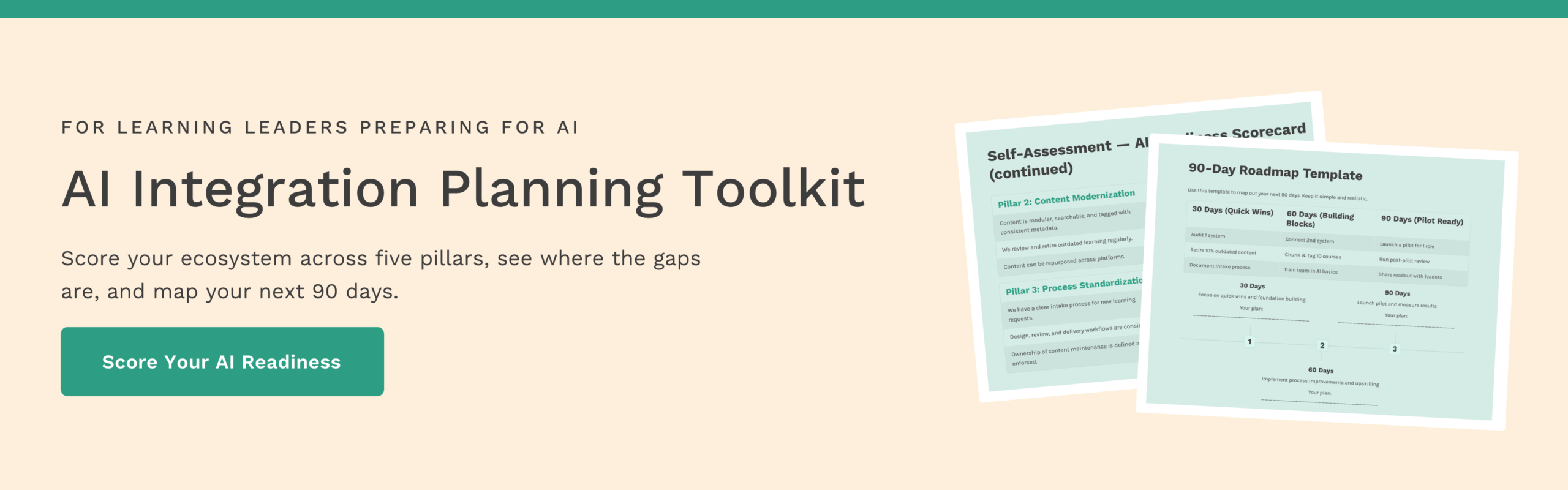
Download the AI Integration Planning Toolkit to identify readiness priorities and plan your next steps. Get the toolkit.
Skills can disappear quietly
Most conversations about AI and workforce development focus on learners, and that’s only part of the story.
When AI begins performing more cognitive work, people stop practicing some of the capabilities that made them effective. A tool that starts as assistance gradually becomes a substitute.
The same risk exists inside learning teams. Instructional designers develop instincts over years of solving messy problems, and learning strategists learn how to question assumptions, identify patterns, and exercise judgment when the answer isn’t obvious. Those capabilities strengthen through use.
When organizations rush to automate the most judgment-intensive parts of the work, they weaken the expertise they still need most. Over time it becomes harder for people to detect weak recommendations, challenge questionable outputs, or recognize when an AI-generated solution misses the mark. The people responsible for judging quality lose the opportunities to practice the skills that make their judgment valuable.
Access gaps often widen before anyone notices
Speed tends to favor people who are already positioned to move quickly. Employees with stronger networks, more confidence, better technology access, or greater freedom to experiment are often the first to benefit from new tools.
On the surface, everything looks successful. Usage increases, participation grows, and adoption goals are met.
Meanwhile, another group is struggling to keep pace. This is one of the easiest risks to miss because aggregate metrics tell a positive story. The dashboard says adoption is working while capability gaps widen underneath.
Fast adoption without deliberate attention to access reinforces differences that already exist inside the organization, and by the time leaders notice, those gaps are much harder to close.
Measured is not the same thing as slow
At this point, someone usually raises a reasonable concern about whether organizations can afford to slow down. Most can’t, and they don’t have to. Measured and slow are not the same thing.
A measured approach means moving at a pace your organization can absorb without creating problems it will spend years trying to fix. Sometimes that pace is fast, and low-risk decisions that are easy to reverse often benefit from speed. Other decisions deserve more care.
Any automated system that influences development opportunities, capability assessments, career visibility, or employee growth carries consequences that extend well beyond the technology itself. Before scaling decisions like those, three questions are worth answering:
- What patterns did the system learn?
- Who remains accountable for the outcomes?
- How will you know when something isn’t working?
It also helps to be intentional about the human capabilities you want to preserve. Some skills are worth protecting before convenience replaces them. Paying attention to who is struggling during adoption, not just what the aggregate numbers show, can reveal issues long before they become organizational problems.
None of that requires moving slowly. It requires paying attention.
The costs that show up later
Most of the damage created by moving too fast in learning is a lagging indicator, and it appears after the launch celebration.
You see it in recommendations employees stop trusting. In decisions nobody can explain. In learning teams that become dependent on tools they no longer know how to challenge. In workforce gaps that widened while the dashboard continued reporting success.
The leaders I would bet on are not asking how quickly they can deploy AI. They’re asking a harder question.
What might our current pace be costing us?
If that question is worth sitting with, the AI Integration Planning Toolkit is a place to start. It walks through the five parts of a learning ecosystem that decide whether AI helps or simply amplifies what is already there: data quality, content, process, talent, and stakeholder alignment. It also includes a 90-day roadmap for whichever one you decide to work on first.