
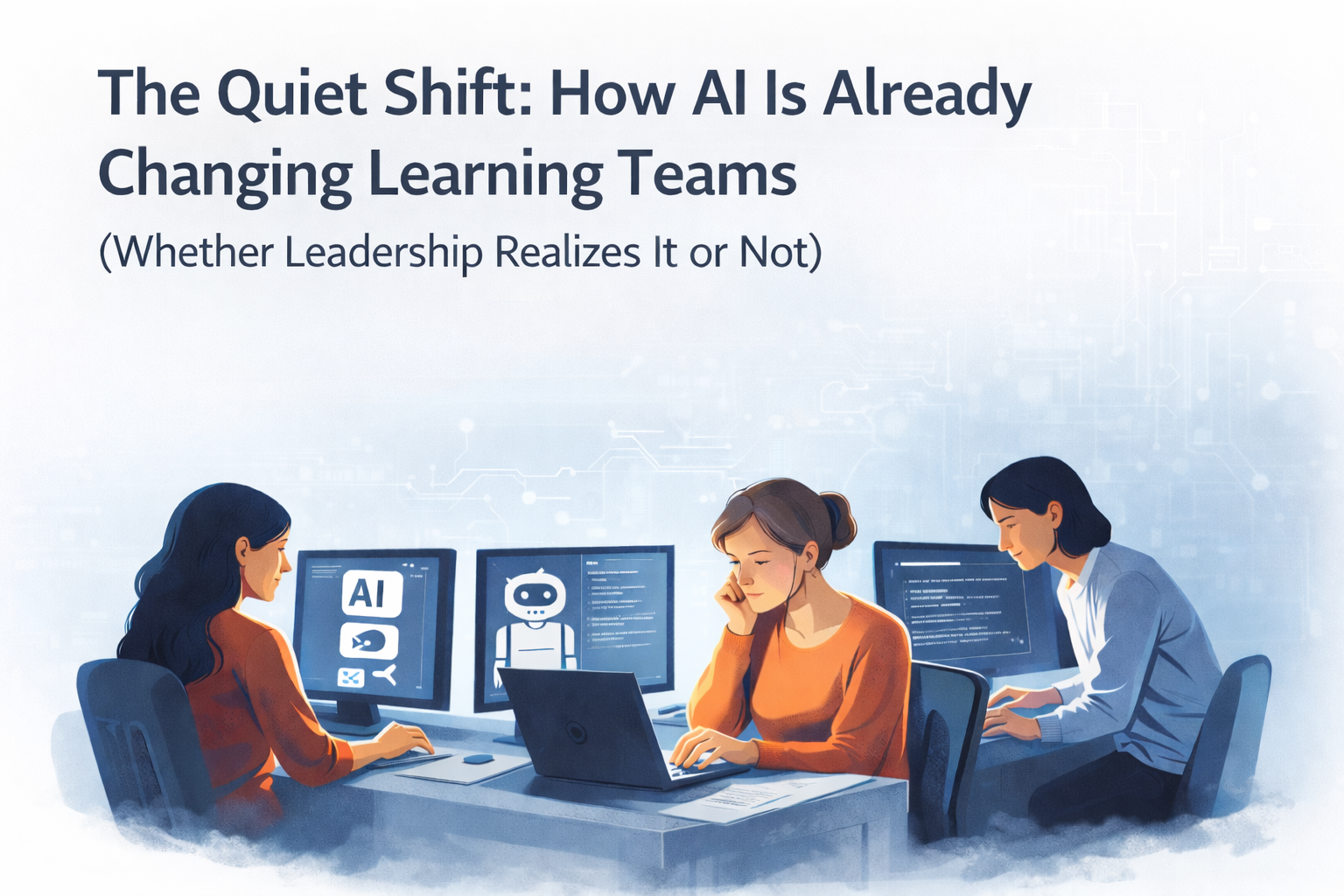
Let me be direct: AI isn’t coming to your learning organization someday in the future. It’s already here, woven into workflows, decisions, and daily habits in ways most leaders haven’t even noticed.
I keep talking with organizations where executives are still debating whether they “need an AI strategy,” while their teams quietly moved on months ago. Not in dramatic, headline-worthy ways. In small, practical, deeply human ways.
Once you know what to look for, the signs are everywhere.
Leadership believes they’re early in their AI journey. Their people are already halfway down the road.
This isn’t rebellion. It’s not even intentional transformation. It’s something more fundamental: people solving their own problems faster than the organization can keep up.
And if you’re not paying attention to these quiet shifts, you’re missing the most important transformation happening in your learning function right now.
The Hidden Reality: AI Adoption Isn’t Starting, It’s Already Underway
Across dozens of conversations with learning teams this year, a pattern has emerged. AI adoption isn’t waiting for strategy, governance, or budget cycles. It’s happening in the gaps, the spaces between formal decisions, where real work gets done.
People aren’t asking for permission. They’re not waiting for training. They’re not lobbying for tools.
They’re adapting.
And the quiet nature of this shift is exactly what makes it so consequential. Because what starts as individual experimentation quickly becomes organizational behavior, without oversight, alignment, or shared standards.
Four Quiet Shifts Reshaping Learning Teams
1. The Great Skill Divide
Your team is splitting into three groups, and the gap is widening every week.
- Early adopters who’ve already integrated AI into their daily workflow
- Experimenters who are curious but inconsistent
- Avoiders who feel overwhelmed, uncertain, or intimidated
The consequences are real:
- Early adopters are accelerating, taking on bigger projects, contributing to strategic conversations, becoming indispensable
- Avoiders are falling behind, not because they lack talent, but because they lack direction
- Experimenters are drifting, either leveling up or opting out
This isn’t just a skills issue. It’s an organizational capability divide forming in real time.
And every week you don’t address it, the gap grows.
2. Shadow Automation Is Everywhere
While leadership forms committees to discuss AI governance, your people have already automated parts of their jobs, quietly, informally, and without documentation.
Not out of defiance. Out of necessity.
I’m seeing:
- First-draft assessments generated in minutes
- Weekly reports automated
- Stakeholder prep streamlined
- Research tasks accelerated
These micro-automations add up to massive productivity gains, and massive organizational risk.
Because when your most productive people build their workflows around unofficial tools:
- You lose visibility
- You lose consistency
- You lose resilience
If those people leave, their AI-enhanced workflows leave with them.
Shadow automation isn’t just a productivity story. It’s a risk story, and most leaders don’t even know it’s happening.
3. Quality Standards Are Quietly Drifting
This one is subtle, and dangerous.
When AI can produce “good enough” content quickly, the definition of “finished work” starts to shift. Not officially. Not in your style guide. But in practice.
I’m seeing:
- AI-generated content sent directly to stakeholders
- Assessments created without pedagogical review
- First drafts treated as final deliverables
- Volume celebrated while outcomes stagnate
The result? A slow erosion of instructional design craft.
Organizations are producing more content than ever, with no measurable improvement in performance. Engagement goes up. Behavior change stays flat.
AI can generate content, but it cannot understand your learners, your culture, or your context.
Without intentional oversight, speed becomes the enemy of quality.
4. The Confidence Crisis
This is the shift leaders miss most often, and it’s the one with the highest cost.
Your people are losing confidence in their professional judgment.
Not because they’re unskilled. Because AI can do parts of their job faster than they can, and they’re not sure what that means for their value.
I’m hearing the same quiet fear across roles:
“I used to feel essential. Now I’m not sure what I bring that a machine can’t do.”
That’s not individual anxiety. That’s organizational capability erosion.
When people stop trusting their instincts, you lose:
- Contextual intelligence
- Pedagogical judgment
- Learner empathy
- Strategic insight
AI should amplify human judgment. But without clarity, people default to whatever feels more efficient, even when it’s wrong.
Why These Quiet Shifts Matter More Than You Think
These aren’t isolated issues. They’re interconnected, and accelerating.
- The skill divide fuels shadow automation
- Shadow automation accelerates quality drift
- Quality drift erodes confidence
- Eroded confidence widens the skill divide
It’s a cycle. And it’s happening whether you acknowledge it or not.
The good news? Quiet shifts are still influenceable. The patterns aren’t locked in. The culture isn’t cemented.
But the window is closing.
What High-Performing Organizations Do Differently
The organizations getting ahead aren’t the ones with the most sophisticated AI strategies. They’re the ones paying attention to what’s already happening, and choosing to lead it.
They:
Make the invisible visible
They create safe spaces for people to share what they’re already doing, without fear, judgment, or consequences.
Set standards before chaos sets in
They define quality benchmarks, review processes, and non-negotiables for AI-assisted work.
Close the skill divide intentionally
They build AI literacy across the team, not tool training, but capability-building.
Build confidence through clarity
They reinforce what AI can’t do and elevate the human skills that remain essential.
Acknowledge reality
They stop planning for a future that’s already here and start leading the transformation that’s already underway.
What This Means for Learning Leaders
If you’re waiting for your industry to mature, for leadership to decide, or for your people to ask for help, you’re already behind.
Your team is adapting with or without you. Your processes are evolving with or without intention. Your standards are shifting with or without design.
The question isn’t whether change is happening. It’s whether you’ll shape it, or react to it when it’s too late.
Seeing these patterns in your organization? Let’s talk about what strategic leadership looks like in your specific context. Every organization’s quiet shift is different, but they all require the same kind of attention.