
You’ve recognized the quiet shift. You’ve seen the signals. You know your people are already experimenting while leadership debates strategy.
So now what?
This is where most learning executives freeze. They know they need to move beyond informal experimentation and into intentional pilots — but the options feel endless, the stakes feel high, and the pressure to “pick the perfect use case” becomes paralyzing.
I’ve been in dozens of conversations lately with smart, capable leaders who are stuck in the paradox of choice. They want a pilot meaningful enough to matter, safe enough to learn from, fast enough to show value, and strategic enough to build momentum.
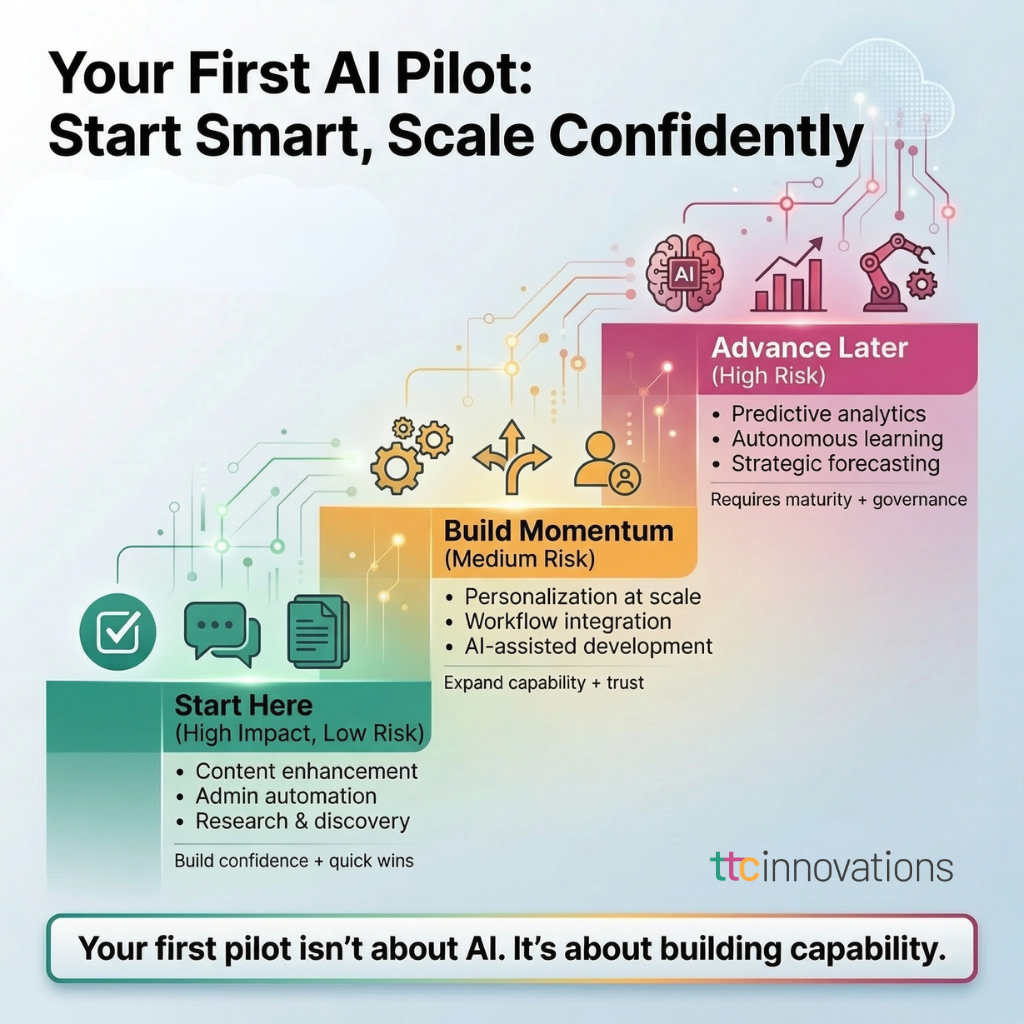
Here’s the truth I keep coming back to: Your first AI pilot isn’t about the technology. It’s about building the organizational muscle you’ll need for everything that comes next.
The organizations getting this right aren’t chasing the flashiest use cases. They’re starting with strategic clarity about what they’re really testing.
The Hidden Reality: Your First Pilot Is Testing More Than You Think
If you think your first AI pilot is simply about whether AI can generate content faster, you’re missing the bigger picture.
Your first pilot is actually testing five foundational capabilities — and most organizations don’t realize it until they’re already struggling.
1. Your Decision‑Making Process
How will you evaluate AI capabilities? Who gets input? What criteria matter? How will you measure success beyond “it works”?
2. Your Quality Standards
What happens when AI can produce content in minutes? Where does human oversight stay essential? How will you maintain pedagogical rigor?
3. Your Change Management Approach
How will you help people adapt to AI-assisted workflows? What fears need addressing? How will you handle resistance?
4. Your Operational Readiness
Do you have the infrastructure, governance, and support systems to scale? Can your current processes handle the velocity AI enables?
5. Your Strategic Positioning
How will AI support your broader talent and capability goals? What future‑ready skills are you building?
Most pilots fail not because the technology disappoints — but because organizations aren’t clear about what they’re actually testing across these dimensions.
The Framework: Start Where Success Builds Success
After watching dozens of pilots across industries, a pattern has emerged. The most successful first experiments share three traits:
- They solve real, acknowledged pain points
- They produce measurable outcomes within 30–60 days
- They create appetite for more sophisticated applications
This is how you build momentum without creating chaos.
With that in mind, here’s how to sequence your early experiments.
Tier 1: Start Here (High Impact, Low Risk)
These are your confidence‑builders — meaningful value with minimal disruption.
Content Enhancement, Not Creation
Don’t start with “AI will write our courses.” Start with:
- Discussion questions
- Role‑play scenarios
- Assessment items
- Variations of existing content
Why it works: You maintain ownership of instructional design while testing efficiency gains. Risk stays low because human‑created content remains the foundation.
Administrative Automation
Pilot AI for the tasks everyone hates, but someone must do:
- Meeting summaries
- First‑draft status reports
- Stakeholder interview prep
- Thematic analysis of transcripts
Why it works: Immediate value, zero threat to creativity, and visible time savings.
Research and Discovery
Use AI to accelerate environmental scanning:
- Industry trends
- Competitive intelligence
- Best practice research
Why it works: AI does the heavy lifting; humans synthesize insights. This positions AI as a capability amplifier, not a replacement.
Tier 2: Build on Early Success (Medium Impact, Medium Risk)
Once your team trusts the technology, you can expand.
Personalization at Scale
Adapt existing content for different roles, levels, or contexts.
Why now: Your team needs confidence in AI’s manipulation abilities before letting it customize their work.
Workflow Integration
Test AI across your learning tech stack:
- Automated tracking
- Intelligent recommendations
- Adaptive assessments
Why now: Integration requires operational maturity and clarity about AI’s limits.
Advanced Content Development
AI drafts; humans design, refine, and contextualize.
Why now: This challenges traditional roles — your team needs early wins before they trust AI with creative tasks.
Tier 3: What Can Wait (High Impact, High Risk)
These are powerful — but only when your organization is ready.
Predictive Analytics and Intervention
Identifying at‑risk learners or forecasting outcomes.
Why wait: Requires robust data, modeling expertise, and comfort with algorithmic decision‑making.
Autonomous Learning Systems
AI adapting content and pacing independently.
Why wait: This is AI making pedagogical decisions. You need strong governance and deep trust before going here.
Strategic Planning and Forecasting
AI recommending learning strategies or predicting skill gaps.
Why wait: This influences organizational direction — not a first‑pilot move.
Setting Your Pilots Up for Success
Here’s what separates successful pilots from expensive experiments:
Start with success criteria, not features
Define what “better” looks like before you begin.
Plan for scale from day one
Don’t pilot something you can’t imagine rolling out broadly.
Document everything
Outcomes, workflow changes, resistance points, and unexpected benefits.
Build change management in, not on
Adoption isn’t an afterthought — it’s part of the experiment.
The Real Success Metric
You’ll know your first AI pilot worked when your team starts asking:
“What should we try next?” —not— “Do we have to do this?”
Successful pilots don’t just prove the technology works. They build confidence. They strengthen capability. They position your learning organization as strategic, not reactive.
The goal isn’t to find the perfect AI use case. It’s to prove you’re the kind of organization that can figure out how to use AI effectively.
Everything else builds from there.
Your Next Move
If you’ve been waiting for clarity, you have it. If you’ve been waiting for a safe entry point, start with Tier 1. If you’ve been waiting for certainty, remember: Learning from a pilot beats perfect planning that never gets implemented.
The organizations pulling ahead aren’t the ones with the most sophisticated AI implementations. They’re the ones building capability while others are still debating where to begin.
Your people are already experimenting. Your competitors are already learning. The real question is whether you’ll step into this moment with intention — or let it pass you by.
Ready to move beyond informal experimentation? Let’s design a pilot strategy that builds organizational capability, not just a technology proof‑of‑concept.
Let’s start a conversation.