
Your initiative didn’t fail because of strategy. It failed because your people weren’t ready.
Every year, organizations invest heavily in digital transformation, system implementations, and strategic initiatives. The business case is clear. The roadmap is defined. Technology is in place.
And yet, results fall short.
For leaders accountable for outcomes, this creates a frustrating reality:
- The strategy was sound
- The investment was significant
- But execution broke down
So, what actually went wrong?
A Real-World Example of Why Business Initiatives Fail
A global financial institution we partnered with invested in a two-year enterprise transformation to replace its commercial credit system, impacting over 1,500 employees across regions and revenue-generating roles.
The rollout was structured. The training plan was in place. The system was launched on time.
But within weeks of go-live:
- Adoption was inconsistent
- Errors in loan origination increased
- Teams struggled to use the system effectively
- Resistance surfaced across the business
Nothing was wrong with the strategy. Nothing was wrong with the system. The breakdown was in execution, how people were (or weren’t) performing. And the business impact was immediate:
- Delays in loan processing
- Increased risk to revenue and customer experience
Why Most Business Initiatives Fail
Most business initiatives don’t fail due to poor strategy. They fail because of a human performance gap.
Organizations invest in:
- Systems
- Processes
- Plans
But underestimate what it takes for people to:
- Adopt new behaviors
- Execute consistently
- Sustain performance under pressure
As a result:
- Employees revert to old ways of working
- Managers fail to reinforce new expectations
- Teams never fully operationalize the change
This isn’t a training issue. It’s a business execution problem.
The Questions Leaders Should Ask Before Go-Live
If you’re leading a transformation, system implementation, or product launch, ask:
- Are our people ready to perform—or just trained?
- What happens 30 days after go-live when support drops off?
- Are managers reinforcing new behaviors—or defaulting to old metrics?
- What will our top performers do when the new process slows them down?
Most organizations don’t design for these moments. And that’s exactly where initiatives fail.
Where Business Initiatives Break Down
In the case above, the failure points were predictable:
- A shift to self-directed learning without performance support
- Learners falling behind and unable to recover
- Hands-on application delayed until the end
- No manager accountability for reinforcement
By the time employees reached real execution, they weren’t ready. And once adoption drops post go-live, recovery becomes significantly more expensive.
Why Execution Failure Is Increasing
Today’s business environment makes execution risk even higher:
- Faster go-live timelines
- Pressure to show immediate ROI
- Continuous transformation cycles
- Less tolerance for underperformance
Leaders don’t have time for teams to “eventually figure it out.” Every week your team isn’t performing at the required level has a measurable business impact.
The Missing Layer: Performance Enablement
The core issue isn’t knowledge.
It’s whether people can perform in real work conditions.
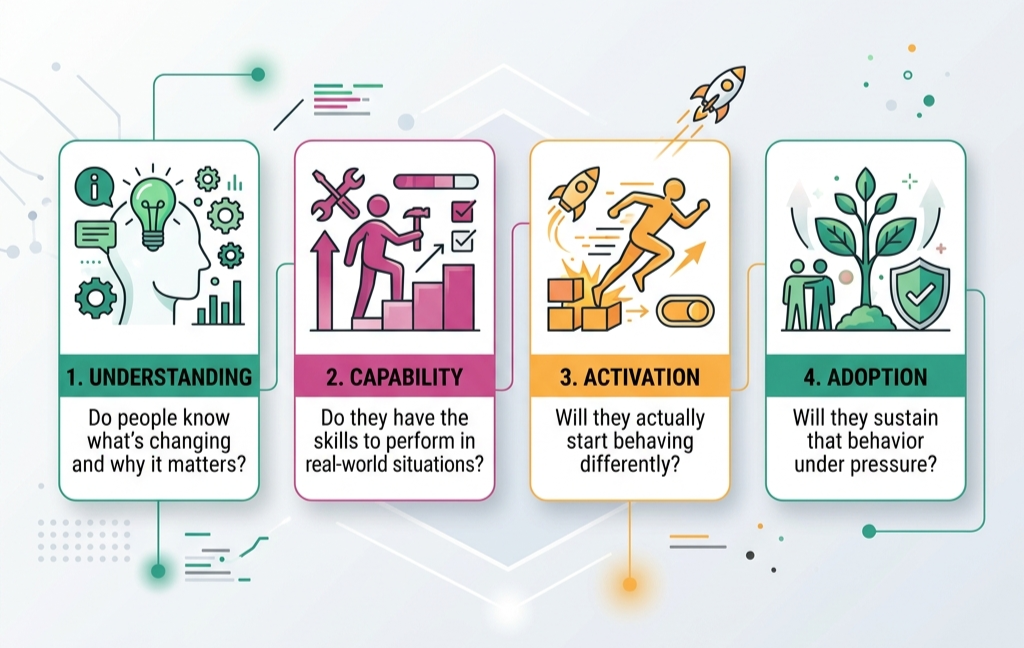
To ensure initiative success, organizations must design for:
- Understanding – Do people know what’s changing and why it matters?
- Capability – Can they execute in real scenarios?
- Activation – Will they change behavior at go-live?
- Adoption – Will they sustain performance over time?
Most organizations focus on the first two and assume the rest will follow. They don’t.
How to Fix the Execution Gap
In this case, the solution wasn’t more training content—it was redesigning for performance:
- Introduced hands-on practice earlier in the process
- Embedded learning into real workflows
- Built manager accountability into the program
- Added real-time support during live execution
The result:
- Improved adoption and consistency
- Reduced disruption to revenue-generating roles
- Increased executive confidence
- Sustainable performance improvement
From Training to Performance: What Leaders Must Do
To prevent initiative failure, leaders must shift from:
- Training programs → Performance enablement systems
- Launch events → Sustained adoption strategies
- Content delivery → Behavior change and execution
Because ultimately: If behavior doesn’t change, the initiative doesn’t succeed.
The Bottom Line
Business initiatives don’t fail because of bad strategy. They fail because organizations don’t design for how people actually perform.
Your initiative didn’t fail because the plan was wrong. It failed because, at the moment execution mattered most, your people weren’t ready.
Close the Execution Gap Before It Costs You
If you’re leading a digital transformation, system implementation, or high-stakes initiative, the question isn’t:
“Do we have a plan?”
It’s:
“Are our people ready to execute it?”
At ttcInnovations, we help organizations close the gap between strategy and execution—so initiatives deliver measurable business results.
👉 Let’s talk about your initiative.
We’ll help you identify where execution is likely to break and how to fix it before it does.