

Learning leaders today are under more pressure than ever to prove the business impact of learning. Dashboards, ROI statements, and performance metrics dominate the conversation — and the expectation is clear: we should be able to draw a direct line between the learning experience and business results.
But here’s the truth:
Focusing on business impact alone doesn’t actually help you improve learning.
Impact data tells you what happened. Curiosity helps you understand why.
And why is where change happens.
Why is where performance improves.
Why is where learning becomes a business driver versus not a cost center.
This is where Curiosity-Driven Learning Measurement begins — and where lasting improvement takes root.
A Story About Real Measurement and Real Improvement
A hospital rolled out a new code blue response training program (for cardiac emergencies). The stakes couldn’t be higher, patient outcomes depended on staff responding quickly and confidently.
The training included:
- Digital learning
- In-person instruction
- Simulation labs
- Clinical observation
After six months, the metrics looked great:
- Response times were faster.
- Patient outcomes improved.
- The impact was visible and meaningful.
It would have been easy to stop there and declare success.
But someone on the data team got curious.
She noticed that some units were improving faster than others and she wanted to know why.
After digging deeper, she discovered something surprising:
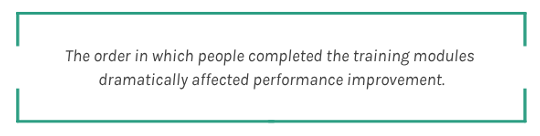
Once the hospital standardized the learning sequence, outcomes improved even more and stayed consistent across teams.
That insight changed everything.
Not because the organization measured impact, but because they followed the data with curiosity.
Introducing Curiosity-Driven Measurement
At ttcInnovations, our measurement approach is built around a simple principle:
Data is a starting point, not an answer.
At ttcInnovations, we believe data is a starting point, not an answer.
Our Curiosity-Driven Measurement model shifts focus from proving value to improving value. It’s built around a simple principle:
Measurement isn’t a report to deliver — it’s a conversation to continue.
This approach helps learning teams:
- Improve performance outcomes, not just report on them
- Identify what’s actually driving improvement
- Avoid misattributing success or failure
- Make learning more efficient and scalable
- Build trust with business partners through meaningful insights
This approach moves you from: “Did the training work?” to “What made the training work and how do we repeat that success?”
Five Practical Ways to Practice Curiosity-Driven Measurement
1. Look for Context, Not Just Correlation
It’s tempting to attribute results directly to learning but external factors matter.
Example: A sales enablement program launches, and sales spike.
Great! But then you learn that a competitor closed eight months earlier and their customers came to you.
Curiosity Question:
What else could explain the change we’re seeing?
Practical Tip:
Partner with operational and business stakeholders early. They hold the context.
2. Start With a Question
Instead of asking “What does the data say?”, ask “Why might this be happening?”
Specific questions lead to targeted insights.
Example:
“Why did engineers adopt this system faster than the last one?”
Because directors were involved in training design and troubleshooting support.
Practical Tip:
Start questions with why, not what.
3. Use Exploratory Data Analysis
Don’t approach the data to confirm an assumption, go in open-minded.
Example:
A pharma company’s training looked effective on average, but when broken down by region, results varied based on cultural alignment of scenarios.
Adjusting to regional relevance improved performance across the board.
Practical Tip:
Slice your data into meaningful segments: region, role, tenure, learning pathway, manager support, etc.
4. Hunt for Outliers
Outliers are clues. They show where something different is happening.
Example:
After an empathy-focused customer service training, scores improved overall except for former top performers. The new scripts actually reduced their authenticity. Removing script requirements restored their excellence.
Practical Tip:
When you see an anomaly:
Ask “What makes this case unique?” instead of discarding it.
5. Create “What If” Scenarios
Generating hypotheses is a powerful tool for guiding your investigation.

Example:
“If the training improved quality, we should also see fewer rework incidents in adjacent teams.” If not, investigate.
Practical Tip:
Use small hypothesis loops, not massive post-mortems.
Why This Matters
By shifting from proving value to improving value, learning becomes:
- More relevant
- More effective
- More trusted by business partners
- Easier to scale across the organization
Curiosity doesn’t slow learning down — it makes learning stick.
Ready to Make Measurement More Insightful and Impactful?
At ttcInnovations, we help organizations turn data into actionable insight through Curiosity-Driven Measurement™.
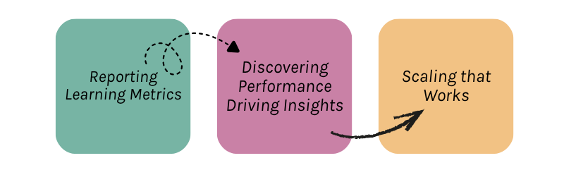
Let’s explore how curiosity can turn your measurement approach into a driver of real performance and business impact.
Book a 30-minute Measurement Strategy Conversation with our team.