
Let’s be honest: The rush toward AI in learning and development isn’t failing because the technology is bad. It’s failing because organizations are solving the wrong problem.
Every week, I talk with learning leaders drowning in AI demos, vendor promises, and pressure to “do something with AI”. Meanwhile, their teams are quietly experimenting with ChatGPT or Microsoft Copilot between meetings, budgets are stuck in committee, and everyone is pretending they have a strategy when what they really have is anxiety dressed up as innovation.
If that sounds familiar, good. It means we can finally talk about what actually matters: AI readiness.
The Readiness Reality Nobody Wants to Discuss
Here’s the uncomfortable truth: Our industry is mistaking motion for progress.
Organizations are buying AI tools the same way they bought LMS platforms in the early 2000s — checking boxes, following trends, and hoping technology will magically fix what is fundamentally an organizational challenge.
But AI is different from every tech wave before it. It doesn’t just change your tools. It changes your operating model.
When content that once took three weeks can now be drafted in three hours, the technology isn’t what breaks. Everything around it does:
- Who owns quality when volume explodes?
- What happens to instructional designers whose value was tied to content creation?
- How do you maintain standards when everyone can generate “good enough” training?
- What does your review process look like when AI can produce fifty variations before lunch?
These aren’t technology questions. They’re organizational readiness questions — and most teams aren’t asking them until it’s too late.
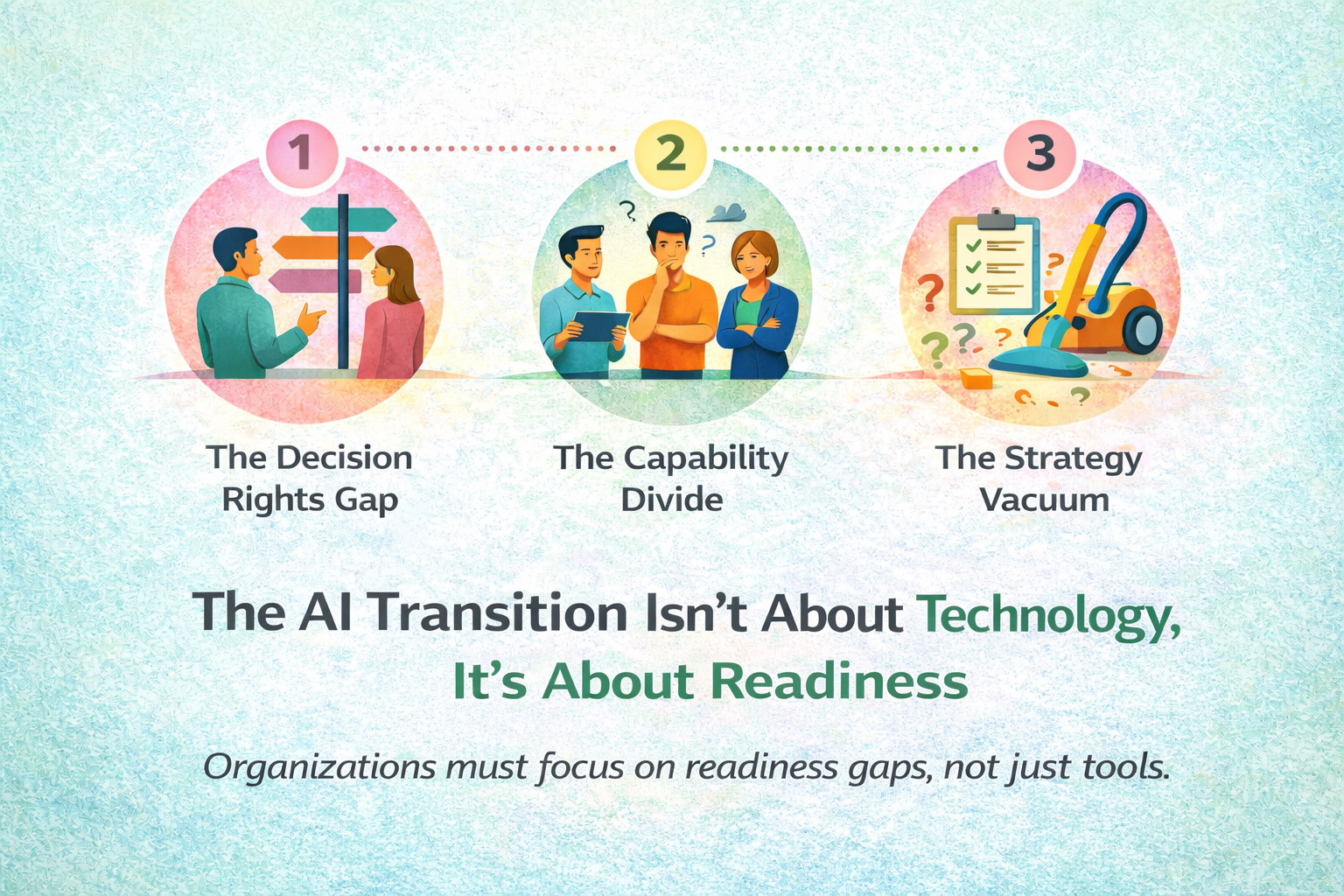
Three Gaps That Will Make or Break Your AI Transition
1. The Decision Rights Gap
Quick test: Who decides what gets automated in your organization? If you had to think about it, that’s your first problem.
AI adoption is happening by stealth — team by team, tool by tool, with no unified strategy. Marketing buys one platform. Operations buys another. Learning gets whatever’s left. Six months later, you’ve built a digital Tower of Babel where nothing connects.
Ready organizations define:
- Who makes automation decisions
- What criteria guide those decisions
- How those decisions align with business outcomes
Without this, AI becomes chaos at scale.
2. The Capability Divide
Your team is already splitting into camps:
- The early adopters who want to automate everything
- The skeptics convinced AI will replace them
- The vast middle who are frozen by uncertainty
None of these positions serve the organization.
You don’t need AI experts. You need AI-literate professionals who understand when to use automation, when to stay human, and how to make informed decisions. That’s a very different capability than “knowing how to prompt ChatGPT.”
3. The Strategy Vacuum
“Everyone else is doing it” is not a strategy. Neither is “we need to be innovative”.
If you can’t articulate the specific problems AI will solve in your learning ecosystem — with measurable impact — you’re not ready.
AI is an amplifier. It accelerates what already exists:
- Efficient processes become lightning fast
- Broken processes fail spectacularly
The question isn’t whether you should adopt AI. The question is whether your foundation can handle the acceleration.
What Ready Organizations Do Differently
The organizations succeeding with AI aren’t the ones with the biggest budgets. They’re the ones who understand that readiness comes before technology.
Here’s what they do:
They start small and specific.
They choose one meaningful use case — automating first‑draft assessments, generating role‑play scenarios, or streamlining content outlines — and build confidence incrementally.
They draw clear boundaries.
They define what stays human. Not every inefficiency needs optimization. Not every process benefits from scale.
They invest in people first.
Before rolling out tools, they build AI literacy across the team: How AI works, what it can actually do, how roles will evolve
They measure what matters.
Not usage statistics. Not adoption rates. They measure impact on learning outcomes and organizational capability.
The Hard Questions You Need to Answer Now
Before you sign another contract or launch another pilot, answer these:
- What specific problems will AI solve that can’t be solved any other way?
- Who owns decisions about what gets automated and what stays human?
- How will you manage the volume and velocity AI enables?
- What happens to quality control when content creation accelerates 10x?
- How will you support team members whose roles fundamentally change?
- What’s your plan for when things go wrong?
If these questions make you uncomfortable, good. The alternative is far worse: expensive tech stacks nobody uses and transformation initiatives that transform nothing.
Your Next Move
After twenty-four years in this field and hundreds of conversations about AI readiness, here’s what I know: The winners won’t be the fastest adopters. They’ll be the most prepared.
AI in learning isn’t a technology project. It’s a rethinking of how learning happens in your organization. That’s daunting — but it’s also an unprecedented opportunity if you’re ready.
Start with readiness. Start with the hard questions. Start with honest conversations about what your organization actually needs.
Because six months from now, I don’t want you to be another cautionary tale. I want you to be the success story others learn from.
Ready to assess your organization’s AI readiness? Let’s talk about what real, practical, sleeves‑rolled‑up transformation looks like.