
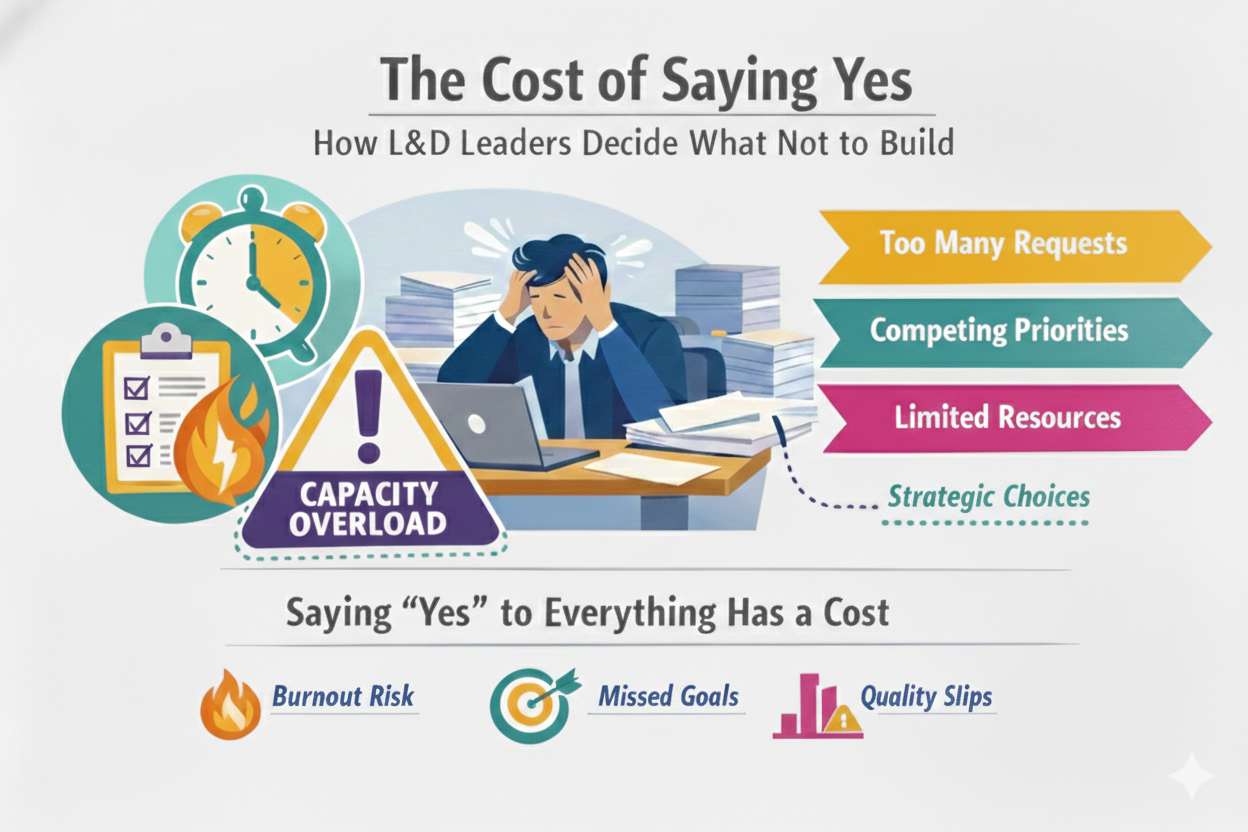
Learning and development teams are under more pressure than ever.
For many senior L&D leaders, the pressure isn’t just operational, its personal.
It shows up in the quiet moments between meetings when you’re replaying a commitment you made, wondering whether your team can realistically deliver it without burning out. It shows up when priorities shift yet again, and you’re left deciding which promise gets broken, and which relationship absorbs the impact. Requests are constant, timelines are compressed, and expectations continue to rise, even as headcount and budgets stay flat.
In this type of environment, many L&D leaders default to a familiar instinct: say yes now, figure it out later.
On the surface, that approach feels collaborative and service oriented. In reality, it comes with a steep and often invisible cost.
At ttcInnovations, we see this pattern across organizations of every size: teams that are talented, committed, and exhausted, not because they lack capability, but because they lack a clear way to decide what not to build.
The Hidden Cost of Always Saying Yes
Most senior L&D leaders don’t struggle with discipline. They struggle with risk.
Saying no can feel risky to relationships, to credibility, to your seat at the table. So instead, leaders absorb the pressure themselves. They shield their teams. They hope things will balance out.
Every new request draws from the same finite pool of capacity. When intake decisions are made informally or emotionally, the impact still compounds:
- Strategic work gets crowded out by urgent, low‑impact requests.
- Credibility erodes when timelines slip or quality suffers.
- Teams become reactive, not because they lack vision, but because the system rewards speed over clarity.
The real risk isn’t that too much work gets done. It’s that the wrong work does.
Why Prioritization Is a Leadership Responsibility
Effective L&D prioritization isn’t about saying no more often—it’s about making decisions more visible, consistent, and defensible.
Strong learning leaders separate intake from execution. They establish shared decision frameworks that answer key questions up front:
- Does this request clearly tie to a business priority?
- Is the expected outcome defined, or just the deliverable?
- What tradeoffs does this decision require?
- Who owns the impact if this work displaces something else?
When these questions are answered early, prioritization becomes a governance conversation, not a personal negotiation.
What an Effective Prioritization Framework Actually Looks Like
Strong intake governance isn’t theoretical. It’s practical, repeatable, and visible. The most effective L&D prioritization frameworks share a few core elements:
1. Clear decision criteria (not just request forms)
Requests are evaluated against a small, agreed-upon set of criteria, such as:
- Alignment to enterprise or functional priorities
- Business impact and risk of not doing the work
- Audience reach and capability lift
- Level of effort and delivery complexity
This shifts conversations from opinion-based to principle-based.
2. Explicit tradeoff conversations
Every “yes” has a cost. Effective leaders make tradeoffs visible by asking:
- What work moves back if this moves forward?
- What capacity is being reallocated?
- What outcome are we prioritizing over another?
When tradeoffs are named early, teams stop absorbing the impact silently.
3. Separation of intake from delivery
Leading organizations treat L&D intake as a governance activity, not an ad hoc conversation with whoever asked first or loudest. Decisions are made in defined forums, on a predictable cadence, with the right stakeholders present.
4. A path other than ‘no’
Not every request needs a full build. Mature intake processes allow for alternatives such as guidance, templates, enablement sessions, or deferral so L&D remains helpful without overcommitting.
These frameworks don’t slow teams down, they remove ambiguity. They give leaders and stakeholders a shared language for decision‑making and create trust that when L&D says “yes,” it actually means yes.
From Order‑Taker to Strategic Partner
L&D leaders who master prioritization change how their function is perceived. They move from being seen as builders of content to stewards of organizational capability.
The hardest part of leadership isn’t delivering more. It’s choosing what deserves attention and having the structure to support that choice.
Even with strong prioritization and intake practices in place, capacity gaps still show up. Critical initiatives collide. Timelines compress. The work that matters most doesn’t always align neatly with the resources available at the moment they’re needed.
That’s where the right kind of partnership can help.
At ttcInnovations, we support learning teams when the work is high-stakes and the pressure is real—whether that means stepping in for a critical initiative, supporting peak demand periods, or helping teams sustain momentum without overextending their people.
If your team is stretched and the work can’t wait, we’re here to help.
Visit our website or book a call to start the conversation.