
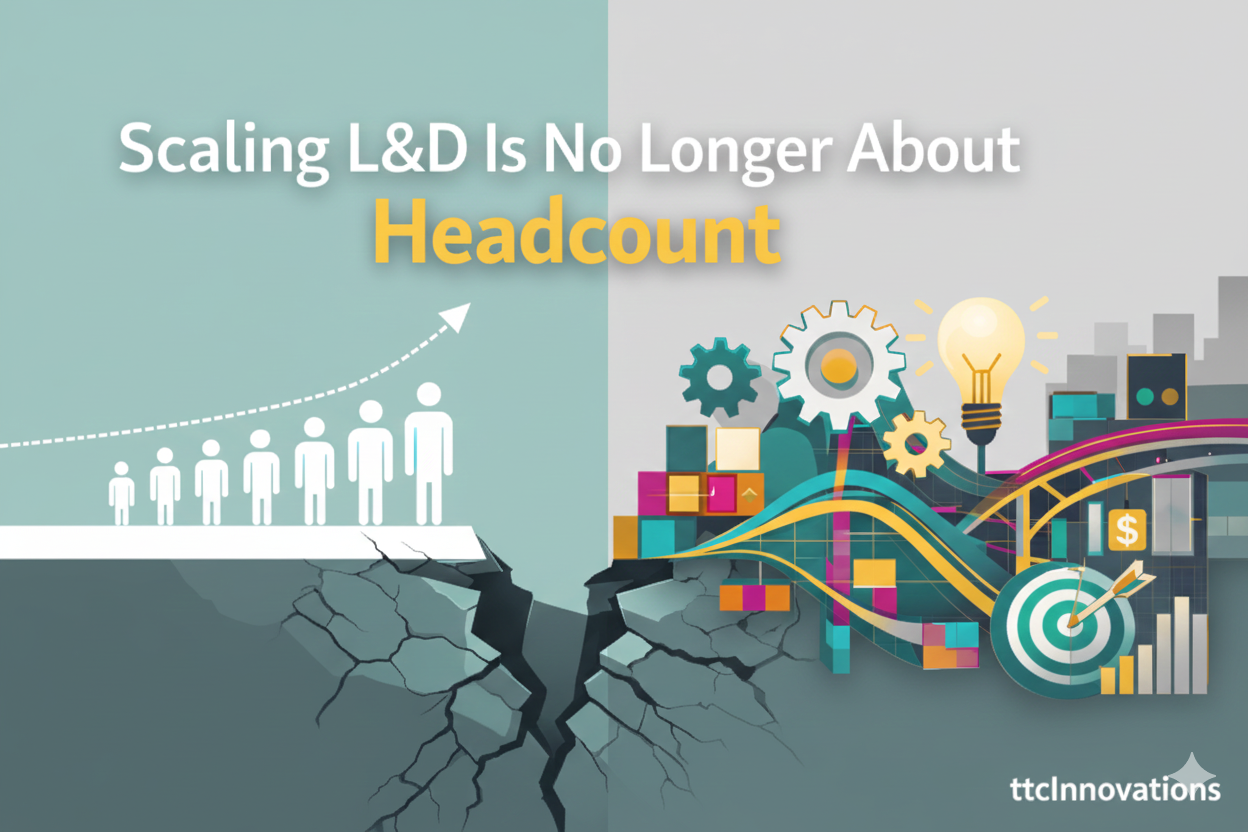
For years, scaling a learning organization followed a familiar equation: more demand meant more people. New initiatives arrived, budgets expanded, and teams grew accordingly. Headcount was the lever learning leaders were expected to pull.
That equation no longer works.
Today’s learning teams operate in environments defined by volatility. Demand doesn’t grow evenly—it surges. Priorities shift midstream. Timelines compress. And permanent headcount, by design, cannot flex fast enough to absorb that variability.
Scaling L&D is no longer a staffing problem. It’s a capacity and risk design problem.
Why Headcount Alone Can’t Keep Up with Modern Learning Demand
Permanent roles assume relative stability. Most learning organizations no longer have that luxury.
Instead, leaders are managing:
- Predictable but intense demand spikes tied to onboarding, compliance, and transformation
- One-time initiatives with executive visibility and non-negotiable timelines
- Competing priorities that disrupt even the most thoughtful roadmaps
Hiring to cover peak demand creates inefficiency for the rest of the year. Hiring for the average leaves teams exposed when pressure rises. In both cases, leaders are forced into reactive decisions—often at the exact moment stability matters most.
Headcount doesn’t lag demand because leaders are slow to act. It lags because it was never designed to solve for volatility.
The Hidden Cost of Misaligned Capacity
Underutilization is rarely visible on a resourcing plan. Teams stay busy. Calendars stay full. Work continues to move.
But when capacity doesn’t align with how demand actually shows up, costs emerge elsewhere:
- Senior talent pulled into execution instead of strategic work
- Increased rework during compressed timelines
- Greater reliance on escalation to keep delivery on track
What often appears to be a performance issue is, in reality, a design issue. Teams aren’t failing, they’re compensating for a system that lacks flexibility.
Volume ≠ Complexity
One of the most persistent traps learning leaders face is treating volume and complexity as interchangeable.
They are not.
Volume requires capacity. Complexity requires judgment, experience, and organizational context.
When these are conflated, organizations either overload their most capable people with volume work or hire for skills they don’t consistently need. Both outcomes reduce effectiveness over time and increase exposure during peak demand.
Peak Demand Is the Real Risk
Most learning teams don’t struggle because of their baseline workload. They struggle because of peaks. Periods when everything arrives at once.
Peak demand introduces risk:
- Delivery timelines become harder to hold
- Quality variability increases on high-visibility work
- Leaders are pulled into execution and escalation
From an executive perspective, this isn’t just an operational challenge. It’s a reliability and credibility issue.
Designing for peaks, not averages, is one of the most important shifts learning leaders can make.
Why Capacity Design Is a Leadership Risk Decision
In constrained environments, leaders are constantly making trade-offs. The question is rarely whether risk exists, its which risks are actively managed, and which are allowed to accumulate.
When learning capacity is rigid, risk compounds quietly:
- Capacity strain becomes delivery instability
- Delivery instability erodes stakeholder confidence
- Eroded confidence leads to increased oversight and escalation
- Escalation reduces control and increases cost
From a short-term view, teams can push through. From a long-term view, the system becomes fragile.
Partnerships as Risk Architecture — Not Extra Capacity
As learning leaders rethink scale, the role of partnerships changes.
Used reactively, external support can increase risk by introducing misalignment, rework, and additional management overhead. Used intentionally, partnerships become part of the control architecture that stabilizes delivery during peak demand.
The partnerships that reduce risk share common traits:
- They are established before pressure peaks
- They integrate into existing ways of working
- They build institutional knowledge over time
- They absorb volume without increasing oversight
These models don’t replace internal teams. They protect them thus preserving focus on complex, high-value work while stabilizing execution when demand surges.
For executives, this distinction matters. In volatile environments, fewer points of failure matter more than raw throughput.
Flexibility Is Now a Core Leadership Competency
Scaling learning organizations today isn’t about building the largest team possible. It’s about designing an ecosystem—people, processes, and partnerships—that holds under pressure.
That requires leadership:
- The discipline to design for variability
- The confidence to move beyond headcount as the primary lever
- The foresight to manage risk before it becomes visible
Strong learning teams aren’t always bigger. They’re better designed and more resilient over time.
If you’re rethinking how your learning organization scales in a constrained environment, it may be time to look beyond headcount and toward how capacity and risk are designed together. We’re working with learning leaders to design flexible, resilient models that protect delivery, credibility, and long-term performance.